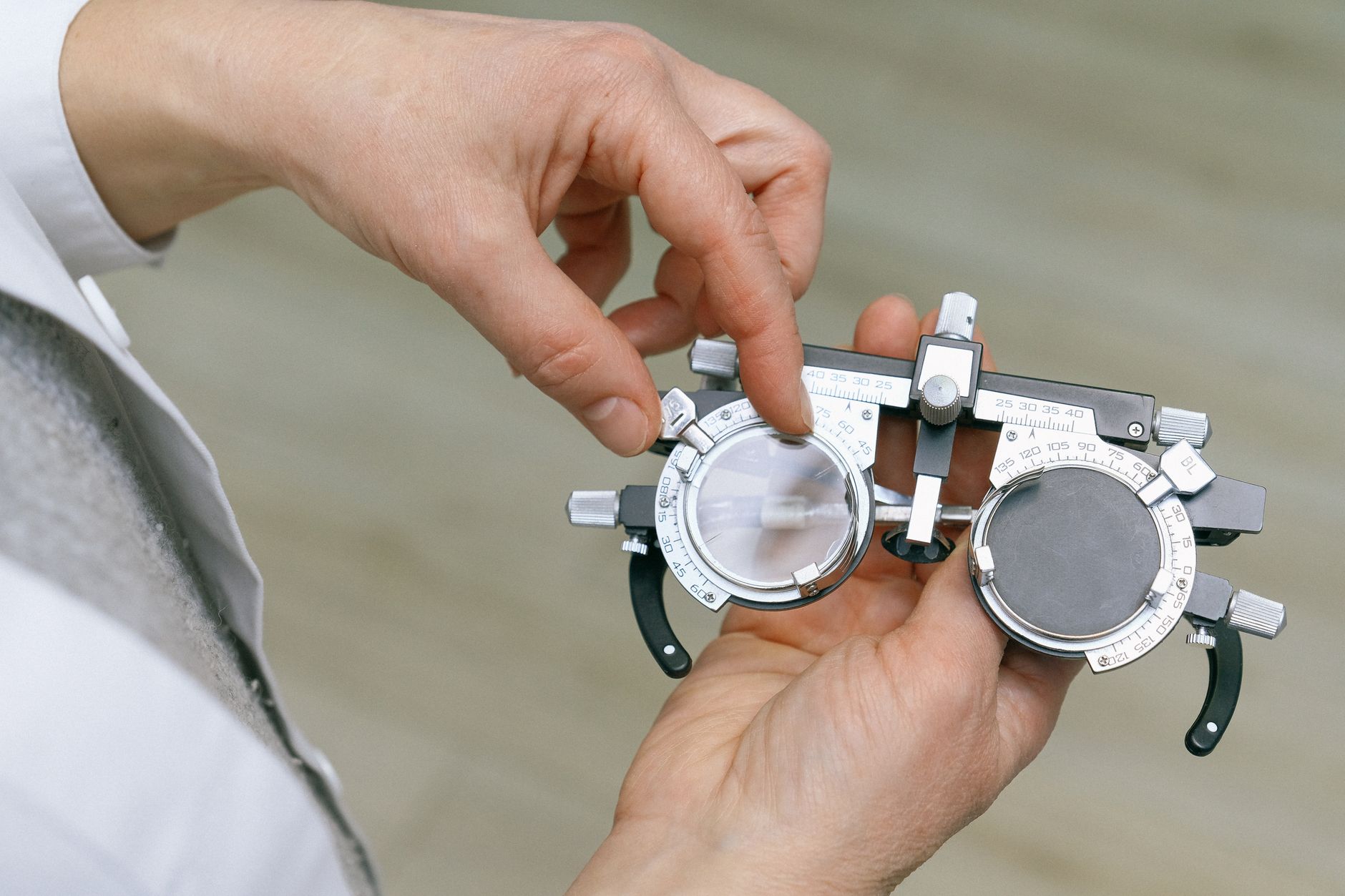
Scleral Contact Lens Fitting: Cost, Process, and What to Expect in Northern Kentucky
By Primary Eye Care Associates12 min read
Medical necessity documentation may allow partial insurance reimbursement for qualifying conditions like keratoconus.
For example, consider a parent in Covington whose 12-year-old child was diagnosed with keratoconus after persistent headaches and blurred vision went undiagnosed by a general optometrist for two years. After the child's first specialty scleral lens fitting evaluation at a practice equipped with Pentacam imaging, three follow-up visits over six weeks produced a custom lens that delivered 20/30 vision, eliminating both the headaches and the need for constant spectacle changes. Medical necessity documentation may allow partial insurance reimbursement for qualifying conditions like keratoconus.
Published: July 1, 2026 | Last Updated: July 1, 2026
What Are Scleral Contact Lenses and Who Needs Them?
Scleral contact lenses are large-diameter rigid gas-permeable lenses. They vault entirely over the cornea. They rest on the white of the eye, called the sclera. Unlike any other lens type, they create a fluid reservoir between the lens and the corneal surface, delivering both optical correction and continuous moisture. This design is medically necessary for many patients. Their corneas are too irregular. Standard soft lenses cannot correct them effectively. Other qualifying diagnoses include pellucid marginal degeneration, post-LASIK ectasia, Stevens-Johnson syndrome, graft-versus-host disease, post-keratoplasty corneas, and severe chronic dry eye unresponsive to medications or IPL therapy for dry eye. Standard soft lenses simply cannot conform to distorted corneal surfaces. Scleral lenses bypass that problem entirely by landing on the less sensitive scleral tissue and correcting vision through a smooth saline interface rather than the irregular corneal surface itself.
How Scleral Lenses Differ from Standard RGP Lenses
Standard rigid gas-permeable lenses typically measure approximately 8.5 to 9.5 mm in diameter (average ~9.4 mm) and rest on the corneal surface; lenses of 10 mm and above are generally classified as large-diameter corneal RGPs. That contact causes significant discomfort on irregular corneas and can accelerate surface damage. Scleral lenses range from 14 to 24 mm in diameter, fully bypassing the cornea. The fluid reservoir under a scleral lens holds preservative-free saline, offering continuous lubrication no other lens type can match. For patients with irregular cornea conditions, vision stability is dramatically better with sclerals because the optical correction travels through the smooth saline layer rather than the distorted corneal surface. The specialty contact lens fitting process required for sclerals is also fundamentally different, involving advanced corneal topography, multiple trial lens evaluations, and precise parameter adjustments that a general optometry practice is rarely equipped to perform.
Which Eye Conditions Qualify as Medically Necessary for Scleral Lenses
The most commonly covered diagnoses for medically necessary contact lenses include moderate-to-advanced keratoconus (when standard contact lenses or spectacles no longer provide adequate correction), pellucid marginal degeneration, and post-keratoplasty corneas following a corneal transplant. Severe dry eye disease that has not responded to conventional topical medical treatments may also qualify. Post-LASIK or post-radial keratotomy ectasia, Stevens-Johnson syndrome, and ocular graft-versus-host disease are additional conditions that typically meet medical necessity criteria; coverage criteria vary by insurer and require documentation that standard alternatives have failed. Documentation from the fitting optometrist is required to pursue insurance reimbursement through a medical plan. This distinction between medical insurance and standard vision coverage is one of the most misunderstood aspects of the entire process, and getting the documentation right at the start saves patients significant time and money.
What Does Scleral Contact Lens Fitting Cost in Northern Kentucky?
Patients in Boone County face total out-of-pocket costs. The range covers three distinct cost components. These include the specialty contact lens fitting evaluation. Trial lens sessions with follow-up visits are included. The final custom-manufactured lenses complete the package. Patients with highly irregular corneas may require more trial iterations, pushing costs toward the higher end of that range. At Primary Eye Care Associates, we use advanced corneal topography and anterior segment OCT from the very first appointment, which reduces the number of trial iterations needed and keeps overall patient costs as low as possible.
What Drives Cost Differences Between Patients
Not every scleral lens fitting costs the same, and understanding why matters before you schedule your first appointment. Corneal complexity is the single biggest driver. A patient with mild keratoconus may achieve an excellent fit in two trial sessions. A patient with advanced irregular cornea conditions or a post-surgical cornea may require four or more parameter adjustments before a final lens is ordered. The diagnostic technology a practice uses also affects cost. Practices relying on basic keratometry produce less precise initial lens selections, meaning more trial-and-error iterations and more visits. Practices with Pentacam or anterior segment OCT produce more accurate first-pass lens selections, reducing the total number of visits. Lens laboratory choice matters too. Premium specialty labs producing fully custom scleral designs charge more than semi-custom options, but they deliver better outcomes for complex cases. Prescription complexity, including high astigmatism, toric peripheral fits, or multifocal scleral designs, adds cost at the manufacturing stage.
Does Insurance Cover Scleral Contact Lens Fitting?
Medical insurance is where meaningful reimbursement becomes possible for patients with qualifying diagnoses. The key is having your optometrist submit appropriate documentation alongside the claim. Northern Kentucky patients near the Greater Cincinnati market have access to both Kentucky and Ohio insurance network variations, so checking both state plan options is worth the extra call. FSA and HSA funds are fully applicable to scleral lens fitting and lenses, providing a straightforward way to manage out-of-pocket costs with pre-tax dollars. Patients should confirm whether their plan includes a specialty contact lens benefit, which is a separate line item from the general contact lens allowance on many medical plans.
How Scleral Lens Cost Compares to Surgical Alternatives
Cost comparisons matter when patients are weighing options. The table below summarizes this comparison directly.
Scleral Lenses vs. Alternatives for Irregular Cornea and Dry Eye Patients
The Scleral Contact Lens Fitting Process: Step by Step
The scleral contact lens fitting process is meaningfully more involved than a standard contact lens fitting. Plan for two to four visits spanning several weeks, not a single appointment. The process begins with advanced diagnostic imaging. It moves through trial lens sessions. Parameters are refined under slit lamp evaluation. It concludes with final lens ordering from a specialty laboratory. An optimal fit must be confirmed first. Each follow-up visit assesses over-refraction, central clearance depth, limbal clearance, and edge lift. The iterative nature of this process is not inefficiency. It is the clinical standard because no two corneas or scleral profiles are alike, and even a fraction of a millimeter difference in sagittal depth changes how the lens vaults over the eye.
What Happens at the Initial Scleral Lens Evaluation Appointment
The first appointment is a specialty contact lens consultation, not a routine eye exam. It runs longer than a standard visit because the practice needs time for multiple diagnostic steps. A comprehensive eye health exam is performed first, including refraction and slit lamp evaluation of the anterior segment. Corneal topography using a Pentacam or equivalent system maps both the anterior and posterior corneal surfaces in high resolution, generating the data used to select the initial trial lens parameters. Anterior segment OCT may also be used to measure the scleral geometry, particularly for larger lens designs or complex post-surgical cases. After reviewing the patient's prior contact lens history and symptoms, the optometrist selects an initial trial lens from the in-office inventory and places it on the eye at this same first visit. Fluorescein evaluation under the slit lamp shows how the lens vaults over the cornea and whether edge clearance is appropriate. The result is an immediate, evidence-based starting point rather than a generic lens selection based on spectacle prescription alone.
How Many Fitting Visits Are Typically Required
Most patients with moderately irregular corneas reach a final lens order after two to three trial fitting visits. Patients with severe keratoconus, advanced post-surgical corneas, or unusually complex scleral profiles may require four or more iterations. Each follow-up visit is a structured assessment: the optometrist checks over-refraction through the trial lens to confirm visual sharpness, measures central clearance to verify the saline reservoir depth is adequate, evaluates limbal clearance to protect limbal stem cells, and inspects edge lift to ensure comfort and tear exchange. This detail matters. A lens with insufficient central clearance will create corneal touch as the day progresses and the saline reservoir thins. A lens with excessive edge lift will allow debris ingress and cause discomfort. Reputable specialty practices include all follow-up visits in the original fitting fee rather than billing per visit, so ask this question explicitly before you book. One concrete example: a Florence, KY patient with stage two keratoconus recently required three fitting visits over five weeks before achieving a confirmed optimal fit, after which vision measured 20/25 through the scleral lens compared to 20/200 with spectacles; individual results vary, and peer-reviewed literature reports a mean of approximately 2-3 trial lens fittings required to achieve an ideal fit.
What Patient Training for Scleral Lenses Involves
The learning curve is real. Scleral lenses are inserted using a small plunger device and a lens bowl filled with preservative-free saline, a technique that feels unfamiliar to patients accustomed to soft lenses or no lenses at all. At Primary Eye Care Associates, our team spends dedicated time at the final dispensing appointment guiding patients through insertion and removal until they are confident before they take lenses home. Patients practice multiple times under staff supervision. Scleral lens care protocols include daily cleaning with either a hydrogen peroxide-based system (fully neutralized before use) or an approved multipurpose solution, strict avoidance of tap water contact, and proper overnight storage. Most patients reach comfortable proficiency within one to two weeks of daily practice. The payoff is clear: all-day comfortable vision that no soft lens or standard RGP lens could deliver for their condition.
Why Choose a Specialty Optometry Practice Over a General Provider for Scleral Lenses
Scleral lens fitting is not a service that scales across high-volume retail optical chains. It requires a Pentacam or equivalent corneal topographer, anterior segment OCT for scleral geometry measurement, a well-stocked trial lens inventory spanning multiple diameters and sagittal depths, and a clinician with genuine experience interpreting complex fluorescein fit patterns. Most general optometry practices and all major retail chains lack at least two of those four requirements. The result is that patients with keratoconus or irregular cornea conditions who visit a non-specialty provider are often told their prescription is difficult, given a soft lens that underperforms, and sent home without a real solution.
Primary Eye Care Associates in Burlington, KY has extensive experience fitting medically necessary contact lenses for patients across Northern Kentucky and Greater Cincinnati. Specialty practices like ours can co-manage patients alongside corneal surgeons and retinal specialists, which matters for keratoconus patients who may eventually progress toward corneal cross-linking or transplant. That coordination does not happen at a retail chain. Appointments are unhurried. The clinician reviewing your topography and adjusting your lens parameters is the same person following your case long-term. That continuity of care produces better outcomes and fewer unnecessary repeat fittings.
What Technology a Qualified Scleral Lens Practice Uses
Equipment determines outcomes in scleral lens fitting. A qualified practice should have corneal topography at the Pentacam or Topcon level, capable of mapping both anterior and posterior corneal surfaces, not just basic keratometry. Anterior segment OCT adds the ability to measure scleral toricity and verify post-fit vault height without estimating from slit lamp observation alone. A properly equipped slit lamp with white light and fluorescein dye evaluation is essential for every trial fitting session. Access to multiple scleral lens laboratories, including Visionary Optics, Valley Contax, and SynergEyes, means the practice is not locked into a single design when standard parameters do not fit a patient's anatomy. Digital fitting software that integrates topography data to suggest initial lens parameters reduces the number of trial-and-error iterations and shortens the overall fitting timeline. Practices that invest in this technology deliver fewer total visits and better first-fit success rates for patients.
How to Get Started with Scleral Contact Lens Fitting in Northern Kentucky
The first step is scheduling a specialty contact lens consultation, not a routine annual exam. This distinction matters because the practice needs to allocate extended appointment time and have the right diagnostic equipment queued and ready. Patients traveling to Burlington, KY from Florence, Erlanger, Covington, Hebron, or across Boone County will find the location centrally accessible within the Northern Kentucky and Greater Cincinnati corridor. When you call, bring clarity about your diagnosis: keratoconus, chronic dry eye, post-surgical cornea, or another complex condition. Bring all prior eyeglass and contact lens prescriptions, your insurance cards including both vision and medical coverage, and a list of current eye medications or drops. That preparation allows the clinician to spend the appointment on your cornea rather than paperwork. Primary Eye Care Associates accepts new patients with complex conditions who have not found relief through conventional care, and our team is accustomed to patients who have already tried multiple soft lens options without success.
What Questions to Ask a Scleral Lens Provider Before Your First Appointment
Before booking, ask the practice these specific questions. How many scleral lens fittings does the practice complete per month? Higher volume indicates clinical experience, not just equipment ownership. What corneal mapping technology is used, and is anterior segment OCT available? Is the fitting fee all-inclusive for follow-up visits, or are additional appointments billed separately? Which scleral lens laboratories does the practice work with, and can they order fully custom designs if standard parameters do not fit? Does the clinician have specific experience with your diagnosis, whether that is keratoconus treatment, post-LASIK vision problems, severe dry eye, or another condition? The answers will quickly reveal whether the practice has genuine specialty depth or is offering scleral lenses as an occasional add-on to a general practice. Results speak louder. An experienced specialty practice will answer these questions without hesitation and provide clear, specific answers. A practice without meaningful scleral lens volume will hedge.
Frequently Asked Questions
How much does scleral contact lens fitting cost in Northern Kentucky?
Total scleral lens fitting costs in Northern Kentucky generally range from $500 to $2,500. This includes the specialty fitting evaluation, corneal mapping, trial lens sessions, and the final custom lenses. Fitting fees alone typically run $300 to $800, with lens costs adding $400 to $1,500 per pair depending on design complexity.
Does medical insurance cover scleral lenses for keratoconus in Kentucky?
Medical insurance plans including Blue Cross Blue Shield, Humana, Aetna, and Anthem may cover portions of scleral lens fitting and lenses when keratoconus or another qualifying diagnosis is documented. Your optometrist must submit a Letter of Medical Necessity. Standard vision plans like VSP or EyeMed typically offer only a small specialty contact lens allowance, not full coverage.
How long does the scleral contact lens fitting process take from start to finish?
Most patients complete the scleral lens fitting process in two to four visits over three to six weeks. Patients with moderately irregular corneas typically finish in two to three sessions. Severe keratoconus or complex post-surgical corneas may require four or more trial fitting visits before final lenses are ordered from the specialty laboratory.
Are scleral lenses comfortable to wear all day?
Yes, scleral lenses are comfortable for all-day wear once patients master the insertion technique, which typically takes one to two weeks of daily practice. The saline reservoir between the lens and cornea provides continuous lubrication, making sclerals more comfortable for patients with dry eye or irregular corneas than any other rigid lens type.
Can scleral lenses be used to treat dry eye disease?
Scleral lenses are a highly effective option for severe chronic dry eye unresponsive to medications or IPL therapy for dry eye. The fluid reservoir under the lens delivers constant moisture to the corneal surface throughout the day. Patients with Stevens-Johnson syndrome, graft-versus-host disease, or post-surgical ocular surface disease are common candidates for scleral lenses for dry eye management.
What is the difference between scleral lenses and standard RGP lenses?
Standard RGP lenses are 9 to 10 mm in diameter and rest directly on the cornea, causing discomfort on irregular surfaces. Scleral lenses are 14 to 24 mm in diameter, vaulting completely over the cornea and landing on the sclera. The fluid reservoir under a scleral lens corrects vision through a smooth saline interface, delivering superior acuity on irregular corneas.
How often do scleral lenses need to be replaced?
Most scleral lenses last one to three years with proper daily care using a peroxide-based cleaning system. Annual follow-up visits are recommended to assess lens condition, check for parameter changes needed due to corneal progression, and verify vault height. Annual replacement and follow-up costs typically run $300 to $600 per year, substantially less than surgical alternatives.
Can children and teenagers be fit with scleral contact lenses?
Yes. Teenagers and, in some cases, younger children with keratoconus or other qualifying conditions can be successfully fit with scleral lenses. Maturity and the ability to follow insertion, removal, and cleaning protocols are the primary considerations. A specialty optometrist will assess each patient individually. Earlier intervention often preserves more functional vision as the condition is managed over time.
What happens if my scleral lenses stop fitting correctly as my keratoconus progresses?
As keratoconus progresses, corneal topography changes and the scleral lens parameters may need adjustment. Your specialty optometrist will monitor vault height and fit at annual visits and can reorder lenses with updated specifications. If progression becomes significant, corneal cross-linking may be recommended alongside scleral lens wear to halt further corneal steepening.
What is the average scleral lens fitting fee in Northern Kentucky?
The specialty fitting fee for scleral lenses in Northern Kentucky typically ranges from $300 to $800, separate from lens costs. This fee covers corneal topography, anterior segment OCT if used, all trial lens sessions, and follow-up visits through final dispensing. Practices that include all follow-up visits in one fee offer the most predictable total cost for patients.
Does insurance cover scleral lens fittings or lenses?
Medical insurance may cover scleral lens fittings and lenses when a qualifying diagnosis like keratoconus is documented, but reimbursement varies by plan. A Letter of Medical Necessity from your optometrist is required. FSA and HSA funds apply to all fitting and lens costs. Standard vision plans rarely cover specialty contact lens fittings beyond a minimal annual allowance.
How many appointments are usually needed for a scleral fitting?
Most patients need two to three trial fitting visits after the initial evaluation before final lenses are ordered. Patients with severe keratoconus, post-surgical corneas, or complex prescriptions may need four or more sessions. Each visit refines lens parameters based on vault height, over-refraction, limbal clearance, and edge lift observed under slit lamp evaluation.
What tests are done before ordering a scleral lens?
The initial evaluation includes a comprehensive eye exam, corneal topography using a Pentacam or equivalent to map anterior and posterior corneal surfaces, and often anterior segment OCT to measure scleral geometry. A slit lamp evaluation with fluorescein assesses the trial lens fit. These tests determine the diameter, sagittal depth, base curve, and peripheral curve parameters of the custom lens.
Which Northern Kentucky clinics fit scleral lenses near Florence?
Primary Eye Care Associates in Burlington, KY is a specialty optometry practice serving Florence, Erlanger, Covington, Hebron, and surrounding Boone County communities. The practice has extensive experience fitting medically necessary contact lenses for keratoconus, dry eye, and post-surgical corneas, using advanced corneal topography and anterior segment OCT for precise scleral lens fitting.
Sources & References
- Successful Management of a Keratoconus Patient With Rarely Used Large-Diameter Corneal RGP Contact Lenses: A Case Report – PMC/NIH[factcheck]
- Publication 502 (2025), Medical and Dental Expenses | Internal Revenue Service[factcheck]
- Use of a Mini-Scleral Lens in Patients with Keratoconus – PMC / NCBI[factcheck]
About the Author
Primary Eye Care Associates
Primary Eye Care Associates is a Burlington, Kentucky optometry practice specializing in advanced diagnostics and treatment for complex eye conditions including dry eye, binocular vision dysfunction, keratoconus, and myopia across Northern Kentucky and Greater Cincinnati.
Related Posts
Orthokeratology vs. Atropine Drops for Childhood Myopia: A Complete Comparison
Both orthokeratology and atropine drops are clinically proven to slow myopia progression in children, but they work very differently and suit different lifestyles. This comparison breaks down effectiveness, safety, cost, and convenience so Northern Kentucky parents can make a confident, informed decision.
9 min read
How Much Does IPL Dry Eye Treatment Cost in Burlington, KY?
IPL dry eye treatment in Burlington, KY typically costs $300 to $600 per session, with most patients needing 3 to 4 sessions for lasting relief. This guide breaks down total costs, what affects pricing, and how Primary Eye Care Associates helps Northern Kentucky patients find long-term dry eye relief.
9 min read